null

Rush Delivery: Estimated 10 Working Days | Customs Duty & VAT (if applicable) Payable by Customer
Authentic Hosenträger Suspenders — Hand-Embroidered Bavarian Braces in Real Leather

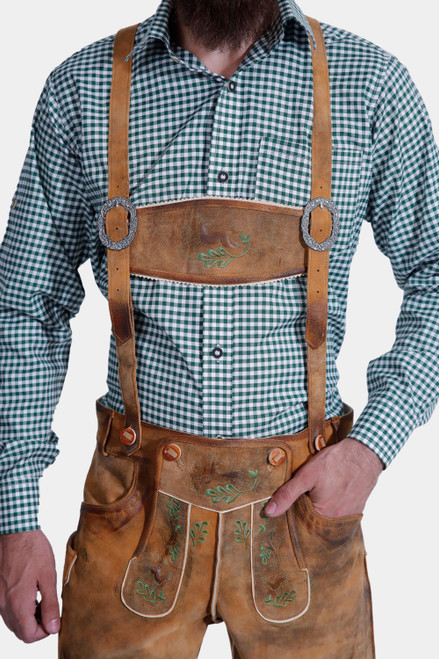
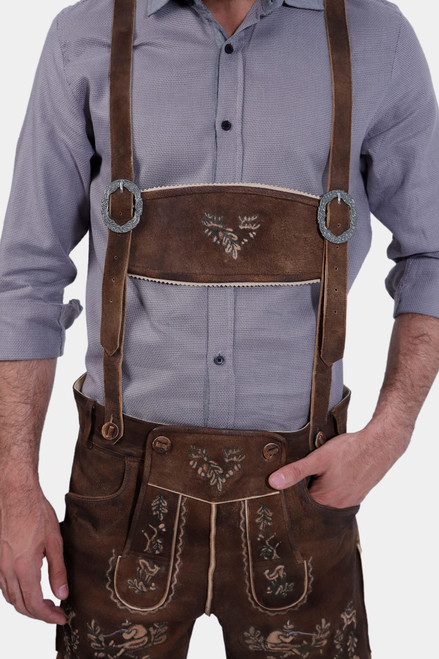
Lederhosen suspenders — known in German as Hosenträger — are traditional Bavarian leather suspenders connecting the front bib of lederhosen across the chest with a horizontal front strap (Steg). Crafted from genuine cowhide, goat suede, or deerskin with hand-stitched Alpine embroidery and horn buttons. The structural piece that defines authentic Trachten silhouette for Oktoberfest 2026.

Lederhosen suspenders — known in German as Hosenträger (literally "trouser carriers") — are leather braces designed specifically to support traditional Bavarian lederhosen. Unlike regular elastic suspenders, authentic Hosenträger feature a decorative chest plate (Steg) with hand-embroidered Bavarian motifs — connecting the two front straps. They attach to the lederhosen via small horn buttons sewn at the front and back of the leather waistband, and they're a non-negotiable part of any complete Trachten outfit.

Most "lederhosen suspenders" sold online are polyester elastic strips with screen-printed "embroidery" that snap or fade after one Oktoberfest. That's not what this collection is. Every pair of Hosenträger here is real goat suede, cow suede, or deerskin leather — finished with hand-embroidered chest plates featuring traditional Bavarian motifs (edelweiss, deer, oak leaf, eagle). Real horn or stag buttons. Adjustable length. Built to last alongside your men's lederhosen for decades. For the complete attachment guide, see our how to put on lederhosen suspenders walkthrough.

Where Lederhosen Suspenders Came From

Hosenträger originated in the Alpine workwear of 18th-century Bavaria and Tyrol — a practical solution to the challenge of keeping heavy leather trousers in place during long days of farm and forest labor. The embroidered chest plate (Steg) evolved from a simple connecting strap into the elaborate decorative element you see today, with each region developing its own embroidery motifs. By the 19th century, codified through Trachtenvereine (Bavarian cultural societies), Hosenträger became one of the most recognizable elements of Bavarian Trachten. Today, they remain the visible difference between authentic lederhosen and a costume. For more Bavarian heritage context, see our complete history of lederhosen.

Hosenträger Shapes — H, Y, or X (The Decision That Matters)

This is the #1 question new buyers ask. The shape refers to how the back straps cross. Each has tradition, function, and best use cases — here's the honest breakdown:

H-Shape (Most Traditional)

Two parallel back straps connected by a horizontal bridge — forming an "H" pattern. The most common, most authentic, and most traditional Hosenträger shape — what locals wear at Munich's Oktoberfest. Distributes weight evenly across both shoulders. Best for all-day wear, formal Trachten events, and long Oktoberfest sessions. If you're buying your first pair, get H-shape.

Y-Shape (Single-Strap Crossover)

Two front straps merge into one center strap that crosses to the back. More casual, slimmer silhouette. Best for warm-weather Oktoberfest, US festivals, and modern styling. Less traditional than H-shape. Often seen with shorter or more compact lederhosen.

X-Shape (Crossed Back)

Two straps cross at the back, forming an "X." Traditional alternative to H-shape, particularly common in Tyrolean and Austrian Alpine regions. Slightly different aesthetic but equally authentic. Best for men with broader shoulders or longer torsos — the X provides more support and movement freedom.

Honest Recommendation: All three shapes are authentic. H is the safe, traditional default. Y is more modern and casual. X is regional and works well for taller men. Don’t overthink the shape — match it to your lederhosen color and embroidery style, and you’re done.
Critical Hosenträger Rule: Hosenträger straps must ALWAYS be crossed at the back — whether H, Y, or X shape. Straight up-and-down straps without crossing are wrong every time. This is the #1 mistake first-time Oktoberfest attendees make. Locals notice immediately.

The Chest Plate (Steg) — Embroidery Meanings

The decorative panel connecting the two front straps is called the Steg in German. It's the most visible part of your Hosenträger and carries authentic Bavarian motifs. Each design has cultural significance:

Edelweiss (Most Popular)

The white Alpine flower — the universal symbol of Bavarian heritage. Edelweiss embroidery is appropriate for everyone, regardless of regional origin or hunting status. The safe traditional choice. Found on the largest variety of authentic Hosenträger.

Stag / Deer Antler

Traditional Bavarian hunting and forester motif. Worn historically by hunters and woodsmen, today by anyone honoring the Alpine outdoor heritage. Bold, masculine, traditional. Pairs especially well with goat suede or deerskin lederhosen.

Oak Leaf (Eichenlaub)

Symbol of strength, longevity, and German heritage. Oak leaves are common in Bavarian heraldry and Alpine folk dress. Often paired with acorn details. Sophisticated, slightly formal choice.

Eagle (Adler)

The Bavarian and German national symbol. Bold, formal, slightly more aggressive aesthetic. Common at Schuhplattler folk dances and serious Trachten events. Pairs well with darker lederhosen.

Initials & Custom Embroidery

Custom Steg embroidery with your initials, family crest, or personal motif. The premium personalized option — Bavarian families often pass down Hosenträger with family monograms across generations.

Pro Tip: The Steg embroidery should match the formality of your event. Edelweiss works everywhere; eagle and oak leaf are slightly more formal; stag and antler skew more rugged. Match the embroidery’s color tone (typically green, brown, or gold thread) to your lederhosen color for the most cohesive look.

Hosenträger Materials

Like lederhosen themselves, suspenders come in three primary leather options. Quality matters because Hosenträger carry weight all day. For the full leather breakdown, see our guide to choosing the right leather.

Goat Suede (Most Popular)

Soft, lightweight, supple — the most common choice. Comfortable across the shoulders even after hours of wear. Develops a slow patina over years. Best paired with goat suede lederhosen. Mid-range price.

Cow Suede

Sturdier and more structured. Most affordable option. Best for first-time buyers or daily-wear durability. Pairs especially well with cowhide lederhosen.

Deerskin (Hirschleder) — Premium

Buttery soft and naturally water-resistant. The most prestigious option and the lifetime piece. Often passed between generations alongside the lederhosen they're paired with. Premium price.

Matching Hosenträger Color to Your Lederhosen

Your suspenders should harmonize with your lederhosen color, not compete with them. Here's the practical matching guide:

  • ✓Brown lederhosen → brown or tan Hosenträger (most common, most versatile)
  • ✓Dark brown lederhosen → dark brown or chocolate Hosenträger (deeper tonal match)
  • ✓Black lederhosen → black Hosenträger (most formal, modern look)
  • ✓Antique grey lederhosen → grey or charcoal Hosenträger (vintage Alpine aesthetic)
  • ✓Forest green lederhosen → brown or olive Hosenträger (rustic country style)
Style Note: Two-tone Hosenträger (where the straps and Steg are different colors) are a modern variation but fully acceptable. They add visual interest while remaining authentic. Some men prefer matching, others prefer subtle contrast — both are correct.

How to Attach Lederhosen Suspenders Properly

Authentic Hosenträger attach to your lederhosen via small horn buttons sewn at the front and back of the leather waistband. Here's the proper attachment sequence:

  1. Find the buttons. Your lederhosen will have 4 small horn or stag buttons — 2 in front (one at each side of the front flap, near the seam), 2 in back (where the H or X crosses).
  2. Attach the front first. Position the chest plate (Steg) in the center of your chest, around the sternum height. Slip the buttonholes on the front leather tabs over the front horn buttons. Steg should sit flat and centered.
  3. Cross at the back. For H-shape: bring the two straps over your shoulders and let them hang straight down at your back. For X-shape: cross them at the shoulder blades. For Y-shape: the single back strap drops to the back center.
  4. Attach the back. Slip the back leather tabs over the back horn buttons. The straps should be snug but not tight — your lederhosen should sit at the natural waist with comfortable support.
  5. Adjust the length. Most Hosenträger have small metal adjusters or buckles on the front straps. Adjust until the chest plate sits at sternum height (mid-chest), not too high or too low.
  6. Test the fit. Reach overhead, sit down, and walk around. The Hosenträger should feel secure but not restrictive. If it pulls your lederhosen up too high, loosen the front adjusters.
Layering Pro Tip: Hosenträger always go OVER your Trachten shirt, never under. The shirt drapes over the lederhosen waistband; the suspenders cross over the shirt and chest. This is the visible Bavarian look that defines the outfit.

Common Lederhosen Suspender Mistakes to Avoid

  • ✗Straight up-and-down straps (not crossed) — The #1 mistake. Hosenträger always cross at the back (H, Y, or X). Parallel straps look obviously wrong to anyone familiar with Trachten.
  • ✗Polyester or elastic costume suspenders — Look obviously fake, smell synthetic, snap or stretch out within one wear. Only buy real leather Hosenträger.
  • ✗Wrong color match — Black Hosenträger with light tan lederhosen looks unbalanced. Match leather tones (or use intentional two-tone) but avoid stark color clashes.
  • ✗Steg too high or too low — The chest plate should sit at sternum height (mid-chest). Too high pulls the suspenders up to your collar; too low makes them sag below the lederhosen.
  • ✗Wearing under the Trachten shirt — Hosenträger always go OVER the shirt, never under. The whole point is the visible decorative chest plate.
  • ✗Overstretched or sagging straps — If your suspenders sag or stretch, they’re too loose. Adjust the front buckles. Sagging Hosenträger make the entire outfit look sloppy.
  • ✗Ill-matched embroidery style — Don’t pair an aggressive eagle Steg with otherwise casual lederhosen, or a feminine floral edelweiss with rugged hunting attire. Match the formality.

How to Size Lederhosen Suspenders

Most Hosenträger come in one adjustable size that fits chest sizes 36"–48". Adjustment buckles on the front straps allow length customization. For larger or smaller frames, custom-cut Hosenträger are available.

Sizing rules:

  • ✓Standard adult Hosenträger fit chest 36"–48" with adjusters
  • ✓Extended sizes available for chest 48"–60"
  • ✓Children’s Hosenträger sized to match our kids lederhosen collection
  • ✓For tall men over 6′2", request our extended length option through Outfit Studio
  • ✓For unusual proportions, custom-fit through Outfit Studio at no extra charge

How to Style Lederhosen Suspenders — Complete the Look

  1. Lederhosen — Suspenders attach to the lederhosen waistband. Match leather color or use intentional two-tone.
  2. Trachten Shirt — Worn UNDER the suspenders. The chest plate sits visibly over the shirt.
  3. Knee-High Socks or Loferl — Complete the outfit from the knee down.
  4. Haferl Shoes — Side-laced traditional Bavarian footwear.
  5. Optional: Bavarian Hat — Tyrolean Alpine hat with feather to top off the look.
  6. Optional: Trachten Vest — A waistcoat goes UNDER the suspenders, between the shirt and the chest plate. Adds polished formality for cooler weather or weddings.

Save 15% when you bundle a complete outfit through our Outfit Studio.

Caring for Your Lederhosen Suspenders

  • ✓Spot clean only with a damp cloth — never machine wash
  • ✓Air dry away from heat if they get wet
  • ✓Store flat or hung — never folded (creases set permanently in leather)
  • ✓Check metal buckles periodically for corrosion or loose stitching
  • ✓Brush gently with a soft microfiber cloth to remove dust after each wear
  • ✓Skip leather conditioner for the first year — let the leather break in naturally

How Much Should Authentic Hosenträger Cost?

Entry Tier ($30–60)

Cow suede Hosenträger with simple machine-stitched embroidery and standard horn buttons. Real leather, proper construction. Lasts 3–5 years. Perfect first pair for first-time Oktoberfest attendees.

Mid Tier ($70–150)

Goat suede or premium cow suede with hand-embroidered Steg, real horn buttons, refined adjustability. The bracket where most repeat wearers settle. Lasts 10+ years with care. Suitable for Munich Oktoberfest and serious Trachten events.

Premium Tier ($180–400+)

Full deerskin (Hirschleder) with full hand-embroidered Steg, custom motif options, and silver or premium horn fittings. The lifetime heirloom — pieces Bavarian families pass down. Ideal for weddings and formal Schuhplattler events.

Why Choose eLederhosen for Your Hosenträger

  • ✓Real Leather, Real Embroidery — every pair is authentic goat suede, cow suede, or deerskin. Hand-embroidered chest plates with traditional Bavarian motifs. No printed or screen-applied "embroidery."
  • ✓Multiple Shapes Available — H, Y, and X-shape Hosenträger in our collection. Choose based on your lederhosen style and personal preference.
  • ✓Custom Sizing Through Outfit Studio — extended sizes for chest 48"–60", custom length for tall men, and unusual proportions through Outfit Studio at no extra charge.
  • ✓US Warehouse, No Surprise Duties — direct shipping from US warehouse. No customs delays, no surprise fees, no waiting weeks for clearance.
  • ✓Bundle a Complete Outfit and Save 15% — combine your Hosenträger with lederhosen, shirt, and shoes through Outfit Studio for 15% off.
  • ✓Free Worldwide Shipping Over $299 — standard delivery 7–14 business days. Express options available.
Oktoberfest 2026 Deadline: Oktoberfest 2026 in Munich runs September 19 – October 4. Order your Hosenträger by September 1, 2026 for guaranteed delivery. Custom-fit pairs require 1-2 weeks of production. Standard pairs ship within 2-5 business days from our US warehouse.

Shop All Hosenträger →  |  Build Your Outfit (Save 10%) →  |  Find Your Size →

Frequently Asked Questions

What are Lederhosen suspenders called in German?

Lederhosen suspenders are called Hosenträger in German. They are traditional leather braces designed to hold up Lederhosen and feature a decorative chest panel.

What is the difference between H, Y, and X-shape suspenders?

The difference lies in the back design. H-shape uses two parallel straps with a connecting bar, Y-shape merges into a single strap, and X-shape crosses at the back. All are authentic styles.

Do Lederhosen suspenders cross in the back?

Yes, authentic suspenders either cross or connect at the back to provide proper support and maintain the traditional appearance.

How do I attach Lederhosen suspenders?

They attach to buttons on the Lederhosen waistband using leather tabs. The front is secured first, followed by the back, and then adjusted for fit.

Do I wear suspenders over or under my shirt?

Suspenders are always worn over the shirt so the decorative chest panel remains visible.

What size suspenders should I choose?

Most suspenders are adjustable and fit a range of chest sizes. Extended sizes are available for larger or taller body types.

What does the embroidery on suspenders represent?

Traditional motifs such as edelweiss, deer, or oak leaves reflect Alpine heritage, nature, and cultural symbolism.

Which leather is best for suspenders?

Goat suede offers comfort, cow suede provides durability, and deerskin is a premium option known for softness and longevity.

Are suspenders necessary for Oktoberfest?

Yes, suspenders are considered an essential part of a traditional Lederhosen outfit at Oktoberfest and similar events.

Can suspenders be worn with regular pants?

Yes, they can be styled with jeans or trousers for a casual look, although they are traditionally designed for Lederhosen.

How long do Lederhosen suspenders last?

High-quality leather suspenders can last 10 to 20 years or more with proper care, depending on the material and usage.

How do I care for Lederhosen suspenders?

Clean with a damp cloth and mild leather cleaner, avoid water exposure, and store flat or on a hanger to maintain shape.

When should I order suspenders for Oktoberfest 2026?

Oktoberfest 2026 takes place from September 19 to October 4. Ordering by early September is recommended to ensure delivery in time.