
Thundering Waters Lederhosen
$169.99 – $219.99
Rush Delivery: Estimated 10 Working Days | Customs Duty & VAT (if applicable) Payable by Customer


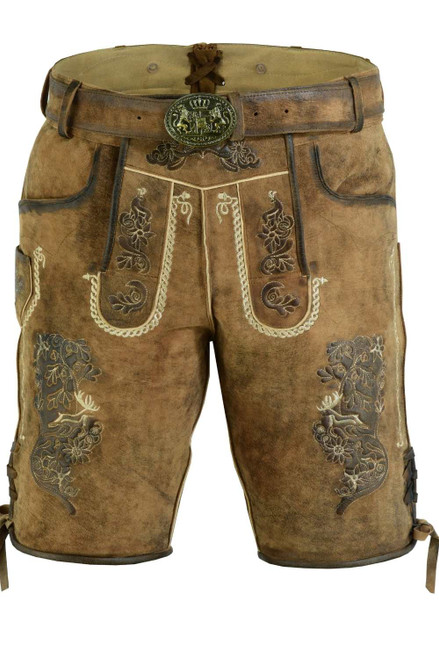


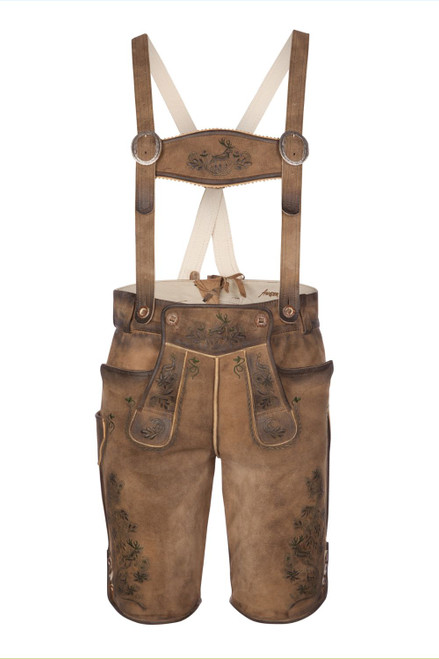

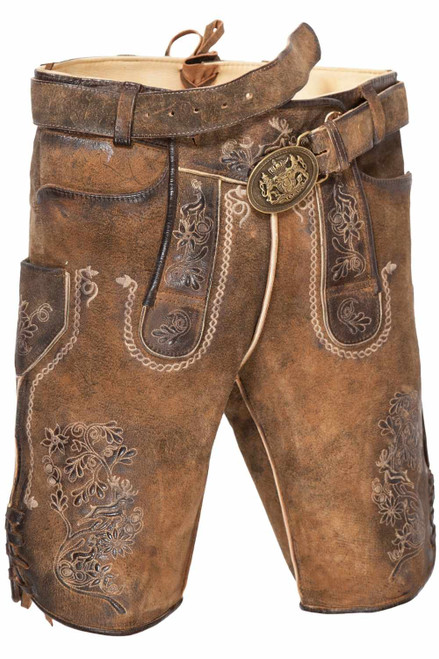


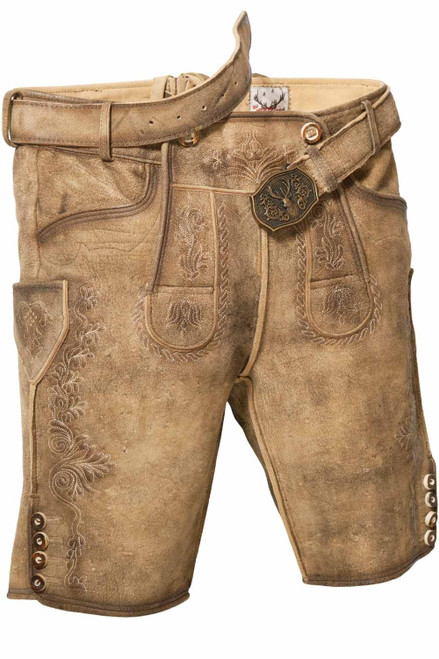


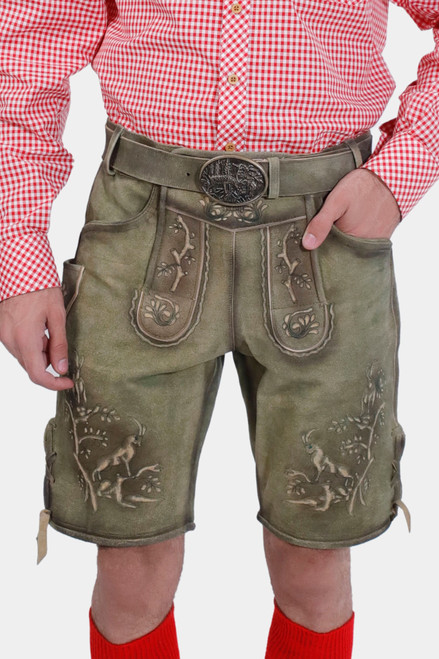


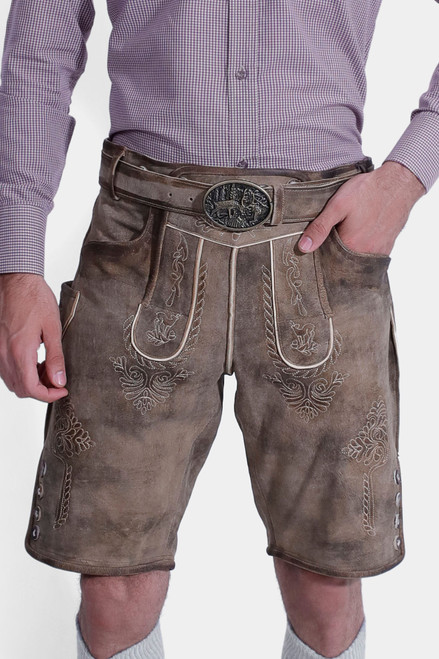
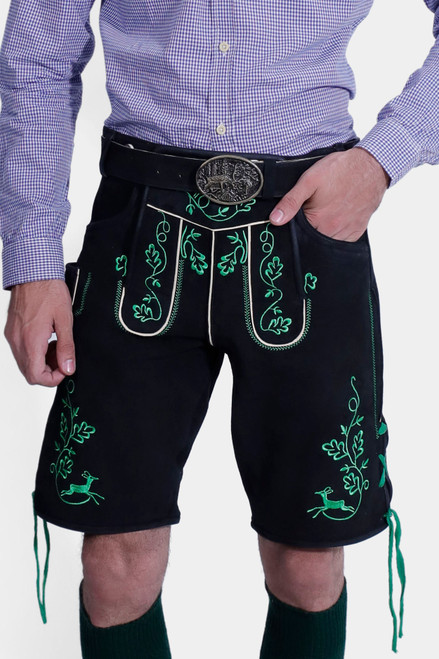
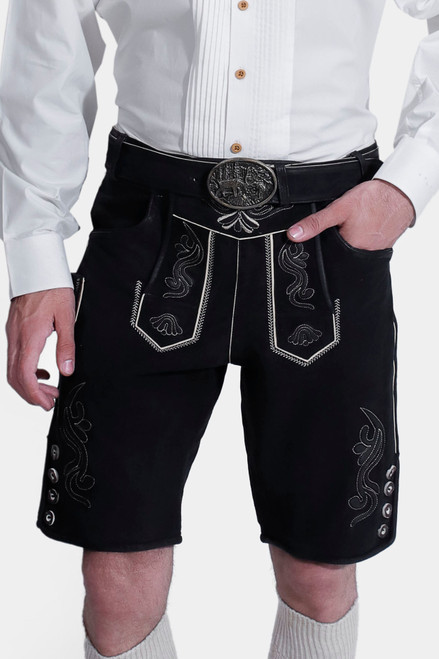


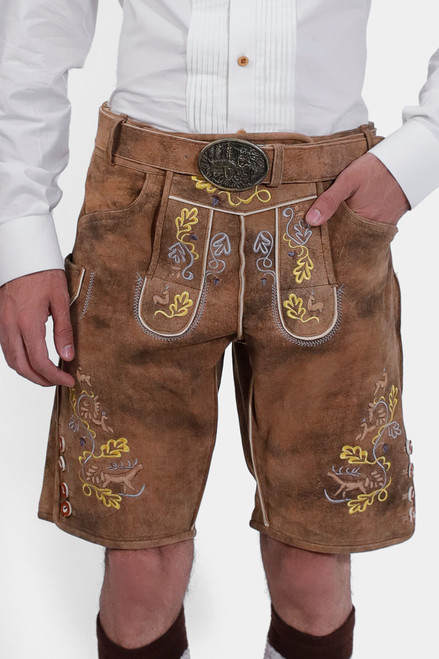


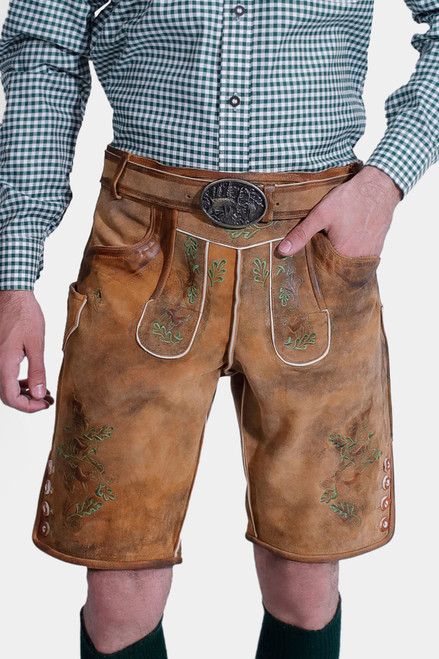


Short lederhosen are not the only authentic Bavarian leather cut — Bundhosen and long lederhosen are equally traditional. The choice between them is occasion-driven, temperature-driven, and function-driven. Here is the honest case for the short cut.
Munich's Theresienwiese reaches 18–22°C inside the heated Festhallen. Short lederhosen end mid-thigh, allowing natural airflow. For US Oktoberfest events in warmer climates — Cincinnati, Texas, California — the argument for Kurze is even stronger.
The Schuhplattler folk dance requires deep knee bends, lateral leg extensions, and thigh slaps. Trachtenverein dancers across Bavaria, Austria, and German-American societies prefer Kurze Lederhosen because the above-the-knee hem does not restrict leg movement.
Walk the six Festhallen in Munich: short lederhosen outnumber all other styles. Local Bavarian men who wear Trachten year-round reach for the Kurze cut for the Wiesn. Bundhosen is the dressier, more formal choice reserved for weddings and cooler events.
For the knee-length dressier cut, see our Bundhosen collection →
The difference between authentic Kurze Lederhosen and a festival costume is not price — it is construction. As the people who make these, we know exactly what separates a piece that lasts three decades from one that fails at its first festival.
The Latz is the hinged rectangular panel at the front of the waistband, fastened with two or three Hirschhorn buttons on each side. In our workshop, the Latz is cut as a separate piece, then double-reinforced at the hinge fold with a leather binding strip before embroidery is applied — preventing the crease from cracking over years of wear.
Historically, this drop-front design allowed Alpine workers to relieve themselves in the field without removing their Hosenträger. French fashion journals of the 18th century credited this distinctly Bavarian feature, calling it à la bavaroise. The authentication test: Costume lederhosen have a decorative sewn panel that does not move. Authentic Kurze Lederhosen have a Latz with individual Hirschhorn buttons that unfasten — genuine Hirschhorn is cool to the touch, never uniformly coloured, and has a slight natural grain.
Authentic embroidery is raised off the leather surface — a technique called Sticheln in traditional Bavarian needlework. The raised height on a properly worked Edelweiß motif is 1–2mm above the leather surface. Run your thumb across the embroidery: authentic Sticheln feels like textured relief. Screen-printed or machine-applied embroidery is flat — a hallmark of costume-grade production.
The small reinforced pocket on the right outer thigh is the Messer-Täschle — the knife pocket. Alpine farmers and hunters originally carried a small Nicker (Trachtenmesser) here. In our short lederhosen, the Messer-Täschle has its own inner binding strip and double top stitch at the opening. On costume shorts, this pocket is either absent or rendered as a decorative stitched line with no structural reinforcement. See our Trachten Knife collection →
The Zugband is the adjustment lacing at the back of the waistband — reinforced eyelets through which a leather thong is threaded to tighten or loosen the waist by several centimetres. Authentic lederhosen use a Zugband because leather stretches with body heat and extended wear. Costume shorts use elastic.
Authentic Hirschhorn is never uniformly coloured: it shows mottled cream, tan, and brown variation within a single button, is cool to the touch, and displays a layered grain structure under close inspection. Plastic and resin buttons are warmer, uniformly coloured, and have a slight sheen that real horn does not.
Short lederhosen are worn with H-shape Hosenträger — suspenders with a horizontal Steg bridge connecting the two vertical straps. The H-front distributes the weight of real leather evenly across both shoulders. For a traditional Kurze Lederhosen look at any Trachtenverein event, the H-front Hosenträger with embroidered Steg is the correct choice. See our Hosenträger collection →
Short lederhosen are produced in three genuine leather types. As the makers, we work with all three daily — including the exact thickness ranges we use in our workshop.
| Leather / German Name | Workshop Thickness | Day-One Feel | Break-In | Best Suited To |
|---|---|---|---|---|
| Goat Suede / Ziegenleder | 1.2–1.4mm | Supple, matte, lightweight — soft from the first wear | Minimal | First purchase, warm weather, everyday Trachten |
| Deerskin / Hirschleder | 1.0–1.3mm | Silky, breathable, naturally water-repellent | 1–2 wears | Heirloom quality, formal Trachten, gifting |
| Cowhide / Rindsleder | 1.4–1.8mm | Structured, firm — rich rugged character after break-in | 3–5 wears | Maximum durability, rough festival use, longevity |
Authentic Bavarian Trachten embroidery is not arbitrary decoration. Each motif carries a meaning developed over centuries of Alpine cultural practice. Knowing what you are wearing is the difference between Trachten and costume.
| German Term | English | Cultural Meaning | Best Occasion |
|---|---|---|---|
| Edelweiß | Edelweiss flower | Alpine purity and rarity. The universal Trachten motif — appropriate for all regions and occasions. The safest traditional choice. | All occasions |
| Eichenlaub + Eichel | Oak leaves + acorn | Strength and longevity. Common in Bavarian heraldry. Slightly more formal than Edelweiß. | Formal Trachten, Trachtenverein events |
| Gamsbock | Chamois stag | Alpine hunting tradition. Worn historically by hunters and foresters. | Schützenfest, hunting festivals, rural Volksfest |
| Enzian | Gentian flower | Alpine wildflower. Regional identity signal — more common in Tyrolean and Salzburg Trachten. | Maifest, spring festivals, Biergarten |
| Bayerischer Löwe | Bavarian lion | The Bavarian state symbol. The most explicitly patriotic Trachten motif. Bold and formal. | Schuhplattler performance, formal Volksfeste |
| Hirsch / Hirschkopf | Stag head | The noble red deer — most prestigious Alpine game. Signals heritage and Alpine cultural pride. | Formal events, gifting, collectors |
Custom embroidery — your own design, family crest, initials, or event year — available through our Custom Studio →
Authentic Kurze Lederhosen are the foundation of a complete Trachten ensemble. Each element has a traditional name and a correct way to combine.
| Piece | German Term | How to Wear | Collection |
|---|---|---|---|
| Suspenders | Hosenträger | H-shape, four attachment points. Steg sits one hand-width below collarbone. H is traditional; Y is modern. | Shop → |
| Shirt | Trachtenhemd | Checked cotton (Karo) in Blau-Weiß, Rot-Weiß, or Grün-Weiß. Tucked in, collar open. White linen for formal events. | Shop → |
| Socks | Loferl / Kniestrümpfe | Loferl = two-piece calf warmer, shin bare. Kniestrümpfe = full knee-high. Both correct; Loferl is more traditional with Kurze. | Shop → |
| Shoes | Haferlschuhe | Side-laced leather shoe with sturdy sole. Dark brown is most traditional. Never trainers or athletic shoes. | Shop → |
| Jacket (optional) | Janker | Loden wool, worn open. For cooler evenings or formal occasions. Vest preferred for dancing. | Shop → |
| Hat (optional) | Filzhut | Stiff felt Alpine hat with feather or Gamsbart trim. Hung on hat hooks in Festzelt rather than worn all evening inside. | Shop → |
| Knife (optional) | Nicker / Trachtenmesser | Small blade in the Messer-Täschle side pocket. Traditional accent piece. | Shop → |
Genuine leather does not behave like fabric. First-time buyers are often surprised by how their short lederhosen feel on arrival. Understanding the break-in process sets correct expectations.
Your Kurze Lederhosen will feel firm — possibly tight — when they arrive. This is intentional. We size to your true waist measurement, not your trouser size (which adds 1–2 inches of ease). The Zugband at the back gives several centimetres of adjustment. The leather will yield; the garment will not stretch out of shape permanently.
Over three extended wears of four or more hours, the leather softens and shapes itself around your body. Ziegenleder moulds fastest — typically after one or two wears. Hirschleder takes two to three. Rindsleder takes the longest — up to five extended wears — but produces the most personalised final fit of the three.
After repeated festival wear, authentic leather develops Patina — the complex, mottled surface sheen that tanning oils produce with body heat and light exposure. It cannot be replicated on vinyl or polyester. A pair of Kurze Lederhosen with ten years of festival Patina is visually richer than a new pair — the opposite of every fabric garment you own.
The most common pre-purchase question. The answer depends on occasion formality, expected temperature, and planned activity.
Authentic German leather shorts are year-round Trachten. The Wiesn is the most visible occasion, but Bavarian and Alpine cultural life extends across a full calendar.
| Occasion | German Term | Season / Context | Notes |
|---|---|---|---|
| Oktoberfest | Wiesn | Late September – October. Munich Theresienwiese + 30+ US festivals | Primary occasion. Short cut is the most worn style in the Festhallen |
| Spring Folk Festival | Maifest | May. Maypole celebrations across Bavaria, Austria, German-American communities | Short lederhosen ideal for the warmer spring Wiesn mood |
| Folk Festival | Volksfest | Year-round. Regional street festivals across Bavaria, Austria, South Tyrol | Universal informal Trachten choice across all Volksfeste |
| Folk Dance | Schuhplattler | Year-round. Trachtenverein rehearsals and performances | Short preferred for unrestricted leg movement in dance |
| Beer Garden | Biergarten | Late spring – early autumn. Outdoor beer gardens across Bavaria | Short lederhosen with casual Trachtenhemd is standard Biergarten wear |
| Alpine Cattle Drive | Almabtrieb | September – October. Alpine herding festivals in Austria and Bavaria | Short worn at more casual Almabtrieb events |
| Marksmen's Festival | Schützenfest | Summer. Rifle club celebrations across Bavaria and Austria | Traditional Trachten expected — short lederhosen appropriate |
| US German-American Events | Germanfest / Steuben Parade | Year-round. Cincinnati, Milwaukee, Chicago, New York, Pennsylvania | Most recognised authentic Trachten at US cultural events |
| True Waist (in) | True Waist (cm) | German Size | US Trouser | UK Trouser | International |
|---|---|---|---|---|---|
| 28″ | 70–73 cm | 42 | 28 | 28 | XXXS |
| 30″ | 74–77 cm | 44 | 29 | 29 | XXS |
| 31″ | 78–81 cm | 46 | 30 | 30 | XS |
| 32″ | 82–85 cm | 48 | 32 | 32 | S |
| 34″ | 86–89 cm | 50 | 34 | 34 | M |
| 36″ | 90–94 cm | 52 | 36 | 36 | L |
| 38″ | 95–99 cm | 54 | 38 | 38 | XL |
| 40″ | 100–104 cm | 56 | 40 | 40 | XXL |
| 42″ | 105–109 cm | 58 | 42 | 42 | 3XL |
| 44″ | 110–114 cm | 60 | 44 | 44 | 4XL |
| 46″ | 115–119 cm | 62 | 46 | 46 | 5XL |
| 48″ | 120–124 cm | 64 | 48 | 48 | 6XL |
| 50″ | 125–129 cm | 66 | 50 | 50 | 7XL |
Our standard sizes cover waist measurements from 28″ (German 42) to 50″ (German 66). For sizes above 66, please contact our team. See our complete Size & Fit Guide for full sizing details.
Short lederhosen are called Kurze Lederhosen in German—Kurze meaning 'short' and Lederhosen meaning 'leather breeches.' The singular form is Kurze Lederhose. In Bavarian usage, they are also known as Wiesn-Hose (Oktoberfest pants) or Trachtenlederhose kurz. The Kurze style ends mid-thigh, above the knee, distinguishing it from Bundhosen (knee-length) and Lange Lederhosen (full-length).
Short lederhosen (Kurze Lederhosen) end around the mid-thigh, approximately 10–15 cm (4–6 inches) above the knee. This above-the-knee length provides greater freedom of movement and better ventilation during warm-weather festivals. Bundhosen, by comparison, extend just below the knee and are fastened with a buckle for a more formal appearance.
Yes. Short lederhosen (Kurze Lederhosen) are the most commonly worn style at Munich Oktoberfest on the Theresienwiese and have long been associated with traditional warm-weather Bavarian festival wear. While knee-length Bundhosen are also authentic, they are generally considered the more formal option for weddings, traditional festivals, and cooler-weather Alpine occasions.
Look for four key features: (1) A functional Latz (drop-front flap) with working Hirschhorn buttons rather than a decorative stitched panel. (2) Raised Sticheln embroidery that stands slightly above the leather instead of being printed or flat. (3) Genuine Hirschhorn buttons, which feel cool to the touch and have natural color variations rather than uniform plastic. (4) A traditional Zugband lace adjustment at the back waistband instead of elastic.
Short lederhosen (Kurze Lederhosen) finish above the knee and are the classic choice for Oktoberfest, warm weather, and traditional Schuhplattler dancing thanks to their unrestricted movement. Bundhosen extend to just below the knee and fasten with a buckle, making them better suited for cooler weather, formal Bavarian events, and traditional weddings. Both styles are authentic Bavarian Trachten.
Measure your natural waist in centimeters around the narrowest part of your waist, approximately one inch above your hip bone, while standing relaxed. Do not rely on your regular trouser size, as standard pants include additional ease that lederhosen sizing does not. If you fall between two sizes, choose the smaller size because genuine leather naturally stretches and molds to your body after a few wears. The traditional Zugband lacing at the back also provides extra adjustability.
Authentic German clothing that embodies the threadwork and silhouettes of true Bavarian heritage. Every piece authentically crafted in real leather and shipped worldwide.
© 2026 eLederhosen. All rights reserved.